3.6 Roadways
3.6B Lane widths
Search Content
Download PDF
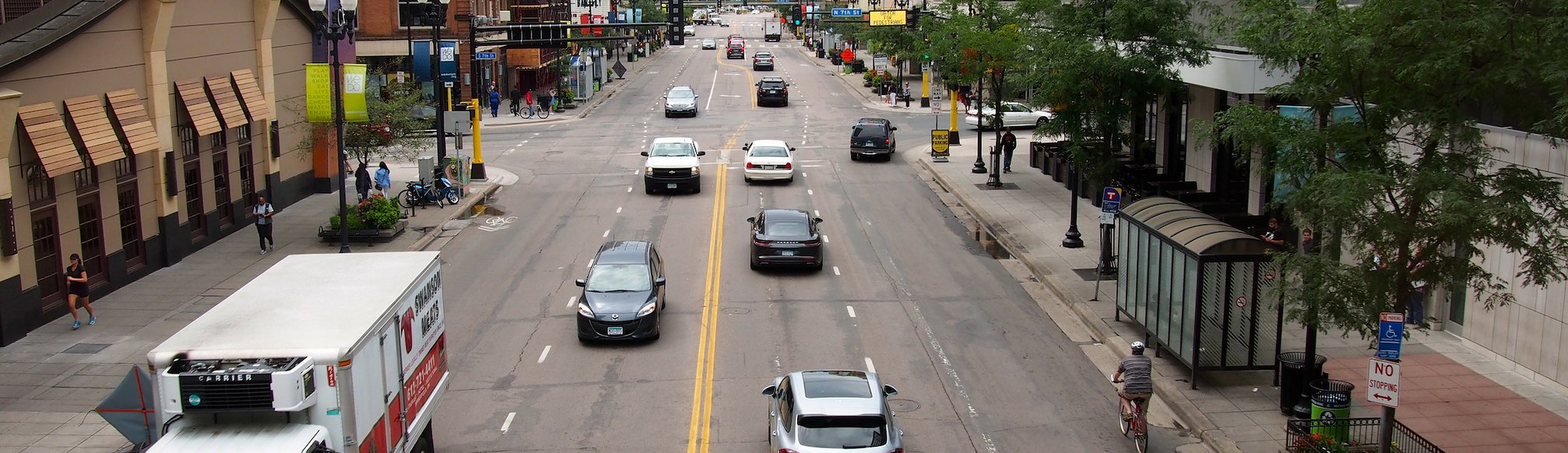
Recommended Widths
Figure 3.6B.1:
Lane widths for all Street Types other than Urban Neighborhood
| Roadway element | Recommended width |
|---|---|
|
Travel lanes |
10’1 |
|
Turn-only lanes |
10’2 |
|
11’ or 10’ if adjacent to 2’ gutter3 |
|
|
6’+4 |
|
|
Gutter pans |
2’5 or 1’ if adjacent to a median |
|
8’6 (includes 2’ gutter) |
|
|
Bus stop pull out |
8’7 (includes 2’ gutter) |
- For streets with high-frequency bus service or heavy semitruck volumes, one travel lane of 11’ in each direction may be considered. Curb adjacent traffic lanes should not be wider than 10’ given the adjacent gutter pan.
- For turn lanes with heavy bus or heavy truck volumes, 11’ may be considered.
- For contraflow bus lanes, 11’ lanes should be used even if adjacent to a 2’ gutter.
- 4’ medians can be considered in constrained right of way.
- For streets with constrained right of way, designers can consider 1’ gutter pans or an integral 11’ wide concrete lane. Flooding concerns may make narrower gutter pans infeasible; coordinate with Surface Water and Sewers.
- 7’ wide parking lanes should be considered in residential areas with constrained right of way. In some industrial areas, 9’ wide parking lanes may be considered.
- In constrained right of way, 7’ wide bus stop pull outs may be considered.
Figure 3.6B.2:
Roadway widths for Urban Neighborhood streets
| Configuration | Recommended width, including gutters |
|---|---|
|
Street with parking on both sides |
30’8 |
|
Two-way street with parking on one side |
24’8 |
|
Two-way street with no parking |
18’-20’ |
|
One-way street with parking on one side |
18’-20’ |
8. For streets with higher than 75% average parking utilization, see design guidance for Urban Neighborhood streets with high parking demand.